By Craig Mattson, Co-Founder & Software Architect
Track a single claim from start to payment. At each step, ask: who or what decides what happens next?
The answer reveals more about an organization than its tech stack ever could.
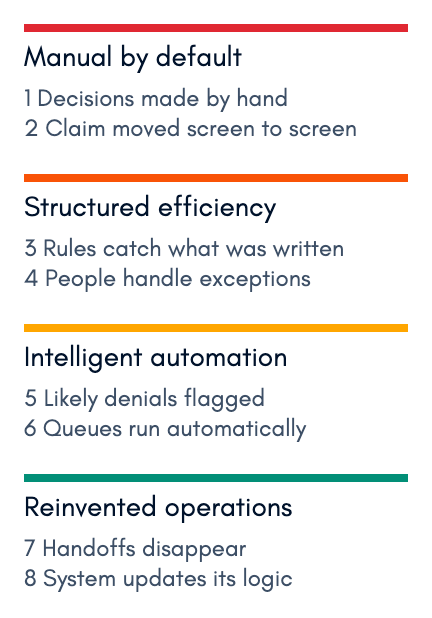
At first, a person makes the decisions. They read the documentation, choose the codes, and submit the claim. Next, the claim is digitized. The data is there, but a person still moves it from screen to screen. Then, rules run before the claim leaves to catch errors. These rules are real, but they only cover what someone wrote down, so people still handle anything that slips through. After that, workflows run, but humans still handle every exception. Later, predictions come in: the system flags likely denials, and someone has to respond. Then, automation processes entire queues. Eventually, handoffs between systems, vendors, and people start to disappear. Finally, the system updates its own logic based on results.
That’s eight steps in four levels of change. Manual by default. Structured efficiency. Intelligent automation. Reinvented operations.
The useful way to read the map is by where the decision logic lives. Early on, it lives in people’s heads. In the middle, it lives in rules and workflows, but those rules are thin. They fail quietly on anything they didn’t anticipate, and a person steps in as a fallback. Each fallback is reasonable in isolation. Added together, they become the operating model.
That’s why the middle is so comfortable. Dashboards work. Reports go out on time. Queues get worked. Nothing is broken enough to force a change. In our experience, most organizations sit at steps two and three, with a person still making every real call.
Costs only change when the system is allowed to act on what it already knows. A better dashboard won’t move you forward. A system that handles known cases on its own will.
“A better dashboard won’t move you forward. A system that handles known cases will. Nothing about that required a new model. It required moving known decisions into the system and fixing the inputs that kept generating the same errors.”
We saw this during a 120-day project with a health system that was behind on accounts receivable. In the first 30 days, automation took care of tasks with clear answers, like small balances, insurance changes, and status checks. Inventory dropped from about 7,000 lines to 5,000. Later, we automated repeat denial patterns and fixed the root causes of rework. By day 90, the backlog was down to 2,500 lines. By day 120, only a small team was handling exceptions.
Nothing about that required a new model. It required moving known decisions into the system and fixing the inputs that kept generating the same errors.
Which step does your best day actually look like, not the one in your strategy deck?