By Kristie Michiels, Director of Forward Deployed Operations
“Over time, we’ve built processes assuming human attention is a free safety net. ... More often, it’s a costly routine repeated thousands of times a week, and most people really don’t question it.”
In most revenue cycle teams, someone's job is to look at a claim that doesn’t need to be modified or touched.
They open it, scan it, confirm what the system already knew, and move on. Nothing is fixed. Nothing is decided. The claim pays exactly as it would have if no one had looked at it. The time is spent, the salary is paid, and the cost is filed away as the price of doing business.
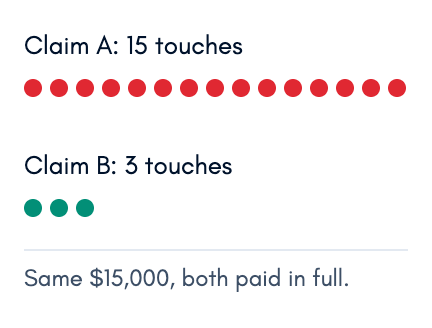
Think about what happens with a difficult claim. For example, a claim that paid $15,000 in full. This example is common. The insurance was entered incorrectly and not verified during registration. Authorization was missing. The first submission was denied. It was rebilled once, appealed twice, and followed up by phone nine times. That’s fifteen touches, most of which could have been avoided with a better front-end process. Now imagine another claim for the same $15,000, but with correct registration, proper authorization, and a clean first submission. Only three touches. The payment is the same. But one claim costs five times more to collect.
Reporting counts both claims as successes, and in a way, they are. The money was received. But the reports never show how much effort was involved.
This is the routine I want us to look at. Revenue cycle work is real and necessary. The issue is the habit of reviewing things that don’t need it. Over time, we’ve built processes assuming human attention is a free safety net. Sometimes that’s true. More often, it’s a costly routine repeated thousands of times a week, and most people really don’t question it.
The people doing this work aren’t the issue. Most are very good at their jobs. The real question is what we ask them to do each day. Are we asking them to make decisions only people can make, or just to confirm what’s already in the record and move the claim forward, or check the status of a claim that was already in process for payment?
Here’s a quick exercise: Think about the last ten claims your team handled. For each one, ask if a person changed the outcome. Did someone make a decision the system couldn’t? Or did they just check a fact that was already in the record or within the payor’s system?
Most people who try this are surprised by the number. Few are surprised by the type. Everyone has seen a claim that didn’t really need their attention.
So, where was that claim in its process, and what could your organization do at that point? That’s the next question, and there’s a way to map it out.