Red Ocean. Blue Ocean.
Why Healthcare Leaders Must Master Both — and How We Bring Them Together
Written By Sal LoPorto, Co-Founder and CEO
Some Background
I've been thinking about something from a conversation last week. Clients shouldn't automatically choose blue ocean ideas or companies unless those companies have shown they can solve today's challenges.
In the early 2000s, INSEAD professors W. Chan Kim and Renée Mauborgne introduced an idea that changed business strategy. In their Harvard Business Review article and later in Blue Ocean Strategy, they described two very different competitive worlds.
Red Oceans are existing markets. They are crowded, competitive, and defined by constant battles for market share. Blue Oceans are new, uncontested spaces. Here, demand is created, competition does not matter, and growth can feel limitless.
This metaphor is especially powerful in healthcare.
New care models, AI-driven workflows, agentic platforms, continuous authorization, and real-time revenue intelligence are emerging. The future feels wide open. The Blue Ocean is calling.
But experience and healthcare history, combined, teach us an important lesson:
You do not earn the right to build the future unless you first understand the pain of the present.
Healthcare is not a blank canvas. It is a dense, complex, and highly regulated Red Ocean. Margins are thin, labor is limited, denials are increasing, and systems are fragile. Leaders are putting out yesterday’s fires while being asked to create tomorrow’s solutions.
If you ignore this reality, Blue Ocean thinking loses its impact.
The Red Ocean: Where Trust Is Built
The Red Ocean is where healthcare organizations live every day:
Registration errors that lead to denials
Authorization delays that stall care and cash
Manual workarounds propping up fragile systems
Policy changes forcing constant operational redesign
This is operational, detailed, and often invisible work isn’t glamorous, but this is where credibility is earned.
When you truly understand today’s denials, edits, workflows, payer behavior, and frontline challenges, you gain something more than strategy. You gain permission. Permission to advise. Permission to redesign. Permission to lead change.
Without that foundation, innovation is theoretical. With that knowledge base, change isn’t just inevitable, it’s pioneering.
The Blue Ocean: Where Value Is Created
Healthcare must not focus only on past optimization.
We are entering an era defined by:
Intelligent automation and agents
Predictive and prescriptive analytics
Continuous authorization and eligibility
Revenue cycle platforms that adapt rather than react
This Blue Ocean is about new ways of operating, not just new technology. Organizations that wait for the future will find themselves competing on shrinking margins in crowded waters. Leaders must do more than buy tools. They need to redesign how work happens.
The Cost of Skipping the Red Ocean
Healthcare offers sobering reminders of what happens when organizations try to jump straight to Blue Ocean ambition without mastering operational reality.
When Amazon, JPMorgan, and Berkshire Hathaway launched Haven, the vision was bold: reinvent employer-sponsored healthcare using scale, data, and purchasing power. If any organization could create a new healthcare category, it should have been them.
Their failure: underestimating the Red Ocean beneath the surface. Provider contracting complexity, benefit design politics, care delivery workflows, and regulatory fragmentation couldn’t be ignored. Despite their resources, Haven quietly disbanded after three years, without much impact other than a story of how not to do it.
Google faced a similar challenge in its early healthcare efforts. They aimed to create a consumer-centered health data platform and unify medical records across systems. The technology was strong, and the brand was trusted. But, again, they underestimated. They miscalculated the burden of workflows, provider incentives, interoperability issues, and regulatory complexity. The platform was eventually shut down.
Lack of brainpower or capital didn’t cause these failures. They were failures of operational fluency.
Even the world’s most powerful technology companies learned the same lesson:
In healthcare, you cannot create a Blue Ocean by bypassing regulations, reimbursement, or workflows.
The Real Advantage: Bridging the Two
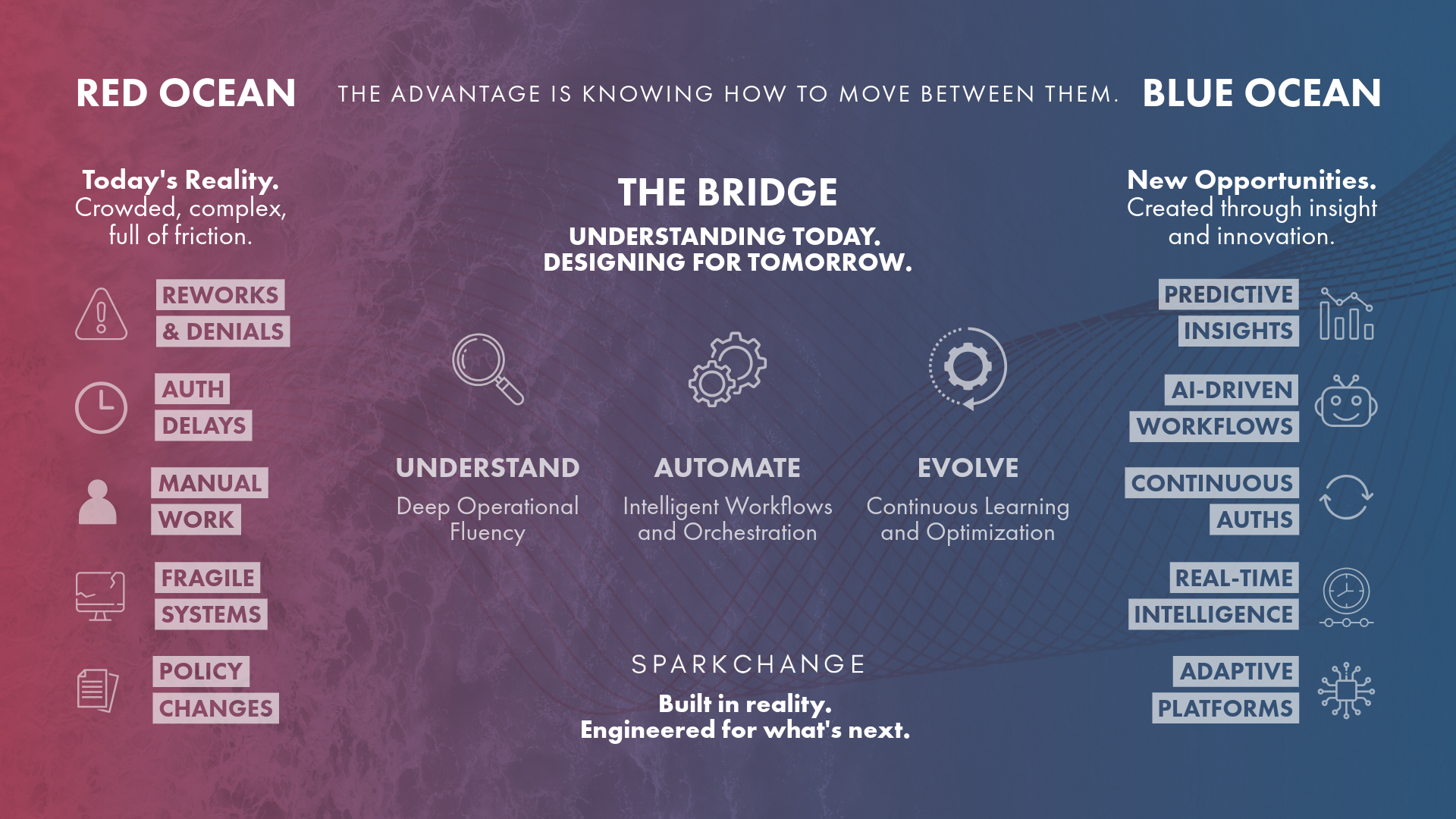
Building a bridge between the two is where real advantage happens. This is the work that matters most. It’s where strategy stops being aspirational and starts being operational.
Kim and Mauborgne’s research found that most successful Blue Oceans were not created by outsiders with abstract ideas. Instead, they were built by leaders who deeply understood their Red Ocean and then redefined it from within.
The biggest opportunity in healthcare is not choosing between Red Ocean or Blue Ocean. It is connecting the two. And this is precisely where SparkChange operates.
SparkChange was built in the Red Ocean.
In denials.
In authorizations.
In edits and eligibility.
In payer behavior and policy change.
In frontline workflows and revenue cycle operations.
We work in the same operational reality that our clients face every day. We understand the constraints, the friction, and what happens when systems fail.
SparkChange is not here just to improve old processes. We are building intelligent automation, intelligence-backed workflows, predictive analytics, and a continuous-learning revenue platform—designed not as abstract innovation, but as practical evolution informed by years of real healthcare operations.
When you truly understand today’s operational constraints, you can:
Identify which innovations actually matter
Design solutions that fit real workflows
Sequence transformation without breaking the system
Help organizations evolve, not just implement
This is where lasting, sustainable partnerships are formed. Not by selling vision alone. Not by fighting fires alone. But by helping organizations move, step by step, from where they are to where they need to go.
Our Responsibility as Leaders
As executives and healthcare leaders, our job is not just to predict the future. It is to turn the future into practical progress.
That means:
Staying grounded in today’s denials, edits, workflows, and payer rules
Investing in what’s next before it becomes urgent
Helping organizations evolve their operating models, not just their technology
In healthcare, reinvention does not happen all at once. It happens through a series of well-designed steps. The most important leaders are those who can stand confidently in the Red Ocean while guiding a real path to the Blue Ocean.
Where We Stand
At SparkChange, this is exactly the work we are committed to doing.
We operate in the Red Ocean every day, inside denials, workflows, payer rules, and operational reality. That’s where trust is earned and where real problems get solved. Because we understand that reality, we can help build a real path to the Blue Ocean, not with hype, but with practical evolution that works.
Safe isn’t our style, and echoing the crowd gets you nowhere. If something’s broken, we call it out and then get to work fixing it for real. We know the grind firsthand, and we don’t shy away from hard problems or from holding ourselves to the same tough standard. That’s leadership. SparkChange moves fast, stays curious, and admits there’s always more to learn. No ego, no shortcuts. If you’re ready to move beyond business as usual and build what’s next without losing sight of what’s real, I’m right there with you. Let’s get after it and spark some real change.